
A one-time sickle cell gene therapy built on base editing has met the main goal of its pivotal trial. Beam Therapeutics announced on November 10, 2026 that its BEACON trial of risto-cel (ristoglogene autogetemcel, formerly BEAM-101) showed patients going at least 12 straight months without a severe vaso-occlusive crisis, the painful blockages that send many people with sickle cell disease to the hospital. The company says it plans to ask the FDA for approval as early as the end of 2026.
If approved, risto-cel would be the first base editing therapy on the U.S. market, according to Beam. It would join two sickle cell gene therapies the FDA already approved in December 2023.
What the BEACON Trial Found
According to Beam, BEACON met its primary efficacy endpoint: freedom from severe vaso-occlusive crises (VOCs) for at least 12 consecutive months, based on independently adjudicated results at a prespecified interim analysis. The trial also met all of its secondary efficacy endpoints, including 12 months without an inpatient hospital stay for a severe VOC, and all primary safety endpoints.
As of the October 20, 2026 data cutoff, 39 adults and 10 adolescents had been treated, and 31 of them had been followed long enough to be counted for the 12-month endpoint. Beam said safety findings matched earlier BEACON reports and the known effects of stem cell collection, busulfan chemotherapy conditioning, and the transplant procedure itself.
How This Sickle Cell Gene Therapy Works
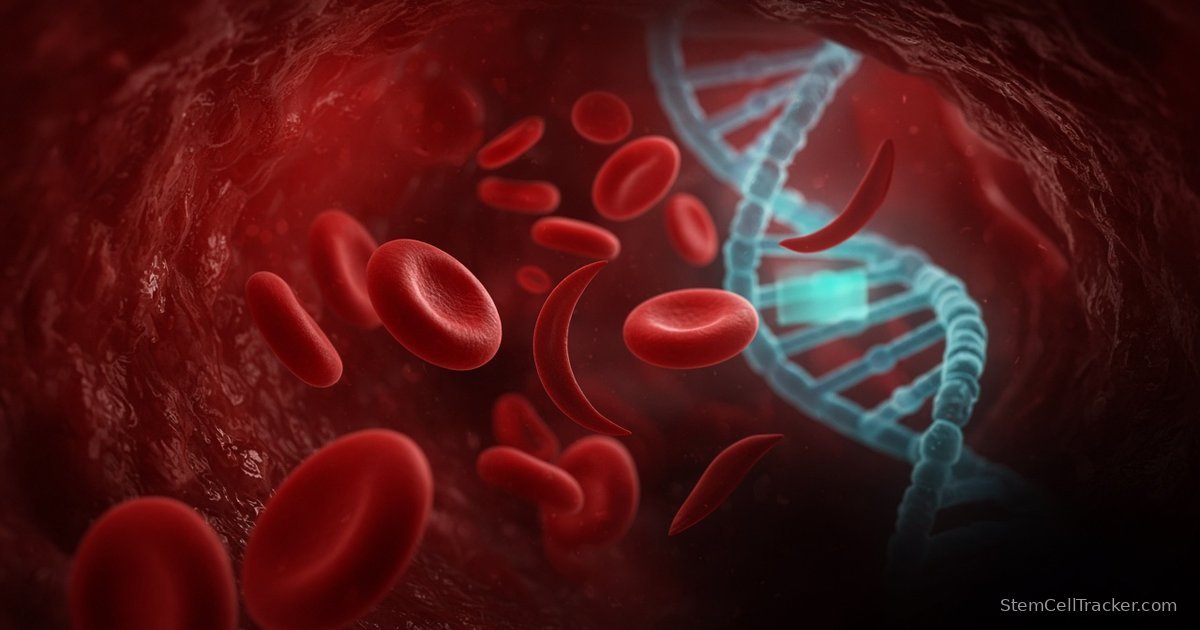
Risto-cel starts with a patient’s own blood-forming stem cells (CD34+ hematopoietic stem and progenitor cells). In the lab, base editing changes single DNA letters in the promoter regions of the HBG1 and HBG2 genes without cutting both strands of DNA. Those edits are designed to block a repressor protein called BCL11A from shutting off fetal hemoglobin, a form of hemoglobin that does not sickle. The edited cells are then returned through a stem cell transplant after chemotherapy clears space in the bone marrow.
The goal is to mimic people who naturally keep making fetal hemoglobin as adults, a condition called hereditary persistence of fetal hemoglobin, which is known to soften sickle cell disease. We covered a different approach, a therapy that directly corrects the sickle mutation, in our report on nula-cel’s early trial results.
Stem Cell Tracker Analysis: What We Found
The headline number is missing. Beam’s announcement says the endpoint was met, but it does not say how many of the 31 evaluable patients actually stayed crisis-free for 12 months, or what share that represents. Beam says detailed pivotal results will be presented at a medical meeting in 2027, with earlier-cutoff data in an oral presentation at the American Society of Hematology (ASH) meeting on December 12 to 15, 2026. Until then, “met the endpoint” is a company summary, not peer-reviewed data.
The trial registry tells a different story on size and goals. The ClinicalTrials.gov entry for BEACON (NCT05456880), checked November 10, still lists an estimated enrollment of 15, ages 12 to 35, a status of active but not recruiting, and a primary completion date of February 2028. Its first listed primary outcome is the change in the yearly number of severe VOCs compared with baseline, not the 12-month crisis-free measure in today’s announcement. The registry also lists engraftment timing and transplant-related deaths within 100 days as primary outcomes. Registry entries often lag behind protocol changes, but readers should know the public record has not caught up with the 49 patients Beam reports treating.
Follow-up will run for 15 years. A separate long-term follow-up study (NCT07373639) plans to track about 50 risto-cel patients through year 15 for side effects, new cancers, bone marrow disorders, and deaths. The trial runs at 19 U.S. sites listed on the registry, including St. Jude, Boston Children’s, Children’s Hospital of Philadelphia, and Memorial Sloan Kettering.
How it compares. In December 2023 the FDA approved Casgevy and Lyfgenia, the first gene therapies for sickle cell disease. Casgevy uses CRISPR to raise fetal hemoglobin through the same BCL11A pathway, and its pivotal results were published in the New England Journal of Medicine in 2024 using the same kind of 12-month crisis-free endpoint. Risto-cel still requires the same harsh busulfan conditioning as those therapies, so its possible advantages, which Beam describes as a “potentially differentiated profile,” will need to be shown in the full data.
What This Means for Patients
Risto-cel is not available yet outside the BEACON study, and the registry shows that trial is no longer recruiting. If Beam files as planned and the FDA accepts the application, a review typically takes many months, so approval would not come before 2027 at the earliest. People with severe sickle cell disease who want a gene therapy today can ask a hematologist about the two FDA-approved options and whether they qualify.
All of these treatments involve collecting stem cells, high-dose chemotherapy, and a hospital stay of several weeks, with risks such as infection and infertility. They are offered at specialized treatment centers, not clinics selling stem cell injections. If a clinic offers a “stem cell cure” for sickle cell disease for cash, review our stem cell clinic red flags checklist first. Talk with your doctor before making any treatment decision. For background on transplant risks, see our report on cutting infections after stem cell transplants.
What Comes Next
The next checkpoints are the ASH presentation in December, Beam’s planned Biologics License Application submission as early as year-end, and full pivotal data in 2027. Beam’s own forward-looking statements note the risk that treatment effects may not last over longer follow-up and that the FDA could ask for more data.
Sources
- Original announcement: Beam Therapeutics, GlobeNewswire, November 10, 2026
- Trial registry: BEACON, NCT05456880, ClinicalTrials.gov
- Long-term follow-up registry: NCT07373639, ClinicalTrials.gov
- FDA: FDA Approves First Gene Therapies to Treat Patients with Sickle Cell Disease
- Study: Exagamglogene Autotemcel for Severe Sickle Cell Disease, NEJM 2024 (PubMed)
Reviewed by T. Lancaster, Editor. Stem Cell Tracker uses AI tools to help research and draft stories; see our Editorial Policy. This article is for education only and is not medical advice.