
Stem cell models used to test new medicines gained another major drug company backer on Wednesday. The International Society for Stem Cell Research (ISSCR) announced that Takeda has joined its Consortium on Advanced Stem Cell-Based Models in Drug Discovery and Development as a Founding Member. The group is working on shared standards so that lab-grown human tissues made from stem cells can be trusted to predict how a drug will behave in people.
For patients, the goal is practical: catch unsafe or ineffective drugs earlier, before they reach clinical trials, and rely less on animal tests that do not always reflect human biology. This is not a treatment and does not change what is available to anyone today.
What the ISSCR Announced
According to the ISSCR, the consortium brings together scientists from universities, government, pharmaceutical and biotech companies, and regulatory organizations. Its stated aims are to set standards, build tools, and create the shared infrastructure needed to “qualify” stem cell-based models, meaning to show that a given model reliably answers a specific drug development question.
Takeda joins existing Founding Members Bayer, Novo Nordisk, R&D Systems by Bio-Techne, the Terasaki Institute for Biomedical Innovation, and the Burroughs Wellcome Fund. The Allen Institute is listed as a Core Member, Xellar Biosystems as a Contributing Member, and the Novo Nordisk Foundation provides foundational support.
“Developing predictive models that more accurately reflect human biology is essential to making better decisions earlier in research and development,” said Gvido Cebers, M.D., Ph.D., Takeda’s Head of Nonclinical Safety & Pharmacology, in the ISSCR release. Consortium co-chair Shuibing Chen, Ph.D., said the aim is to move promising models “from individual laboratories toward robust, reproducible tools.”
What Are Stem Cell Models in Drug Discovery?
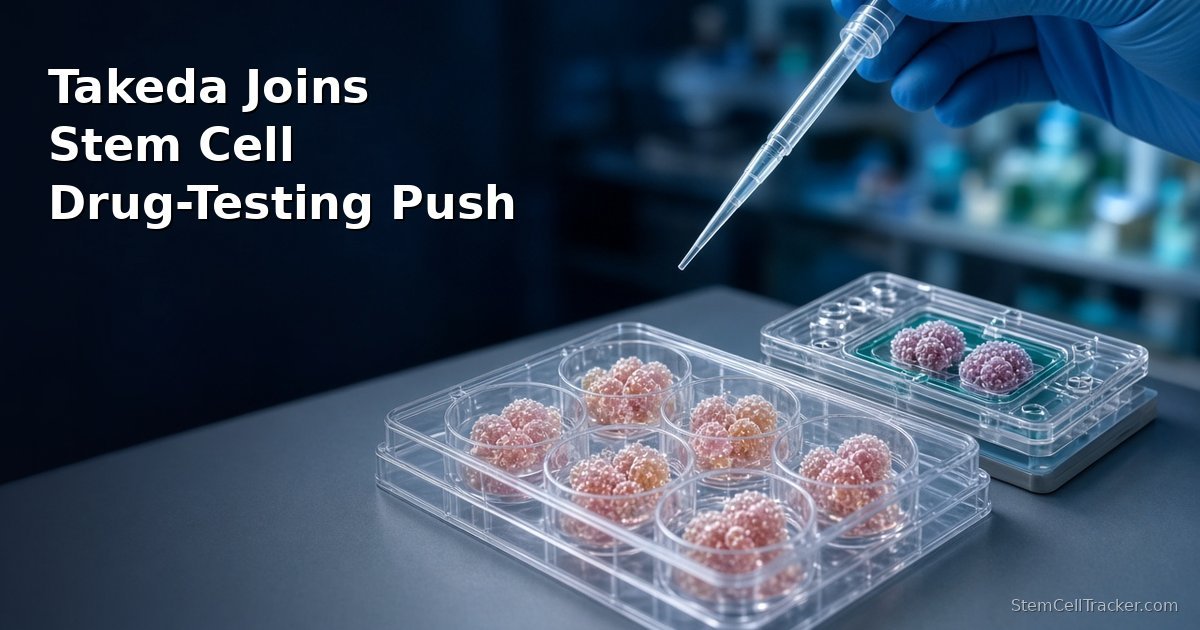
Stem cell models are human cells, small 3D tissues called organoids, or “organ-on-a-chip” devices grown from pluripotent stem cells, including induced pluripotent stem (iPS) cells made from adult skin or blood. Researchers can turn these cells into heart, liver, brain, or other cell types and expose them to a drug candidate to look for toxic effects or signs that the drug works. If you are new to the basics, our guide What Are Stem Cells? explains how these cells differ.
Regulators group these tools under the label “new approach methodologies,” or NAMs, which also covers computer models. The ISSCR release ties the consortium’s timing to growing policy and regulatory interest in NAMs.
Stem Cell Tracker Analysis
The regulatory backdrop is real. In December 2022, the FDA Modernization Act 2.0 removed the long-standing U.S. legal requirement that new drugs be tested in animals before human trials, as Science reported in January 2023. On April 10, 2025, the FDA announced a plan to reduce, refine, or potentially replace animal testing for monoclonal antibodies and other drugs, naming lab-grown human organoids, organ-on-a-chip systems, and computer models as alternatives. The agency said it would encourage NAMs data in investigational new drug applications right away.
Why standards are the bottleneck. A drug company can only lean on a stem cell model if regulators accept that the model gives consistent answers across labs and batches of cells. That validation step is what the consortium says it is building, and it is the gap a single company cannot close alone. The ISSCR has already published broader Standards for Human Stem Cell Use in Research covering cell quality and reporting, which gives the new effort a starting point.
What the announcement does not say. The release does not disclose Takeda’s financial contribution, any specific models or diseases Takeda will work on, or a timeline for when qualified models or published standards will be available. It also does not claim that any animal tests will be replaced on a set date. Readers should treat this as an industry commitment to build standards, not as evidence that stem cell models are already ready to replace existing safety testing.
A small correction to note: the ISSCR’s published release spells the company’s name “Takada” in several places, while the quoted executive’s title identifies Takeda. We refer to the company as Takeda throughout.
How This Connects to Stem Cell Therapies
The same iPS cell technology behind these drug-testing models also powers cell therapies now reaching patients in some countries, such as the iPS cell transplant for Parkinson’s disease recently given to a first patient in Japan. Drug-testing models and cell therapies are different uses, but better standards for making and checking stem cell-derived tissue could help both fields. Our explainer video, Stem Cells Explained, covers the main cell types involved.
What This Means for Patients
This news is about how medicines get tested, not about a new treatment. Nothing from it is available to patients today, and it does not change how any current therapy is used.
Over the longer term, if stem cell models become standardized and accepted by regulators, they could help drug developers spot liver, heart, or other toxicity earlier and drop weak drug candidates before people enroll in trials. That could make trials somewhat safer and, in some cases, faster. Realistically, that shift will take years, and animal and human studies are still part of how drugs are approved now.
Be cautious of clinics that point to headlines like this to market stem cell injections. Lab models used for drug testing are not treatments. Our guide to stem cell clinic red flags can help you spot unproven offers. If you have questions about a clinical trial or treatment option, talk with your doctor.
Sources
- Original announcement: The ISSCR Announces Takeda as a Founding Member of Consortium to Advance Stem Cell-Based Models in Drug Discovery and Development, ISSCR, November 11, 2026
- FDA: FDA Announces Plan to Phase Out Animal Testing Requirement for Monoclonal Antibodies and Other Drugs, April 10, 2025
- News report: Wadman M. FDA no longer has to require animal testing for new drugs. Science, January 2023
- ISSCR: Standards for Human Stem Cell Use in Research
- ISSCR: Disease Modeling and Drug Discovery
Reviewed by T. Lancaster, Editor. Stem Cell Tracker uses AI tools to help research and draft stories; see our Editorial Policy. This article is for education only and is not medical advice.