
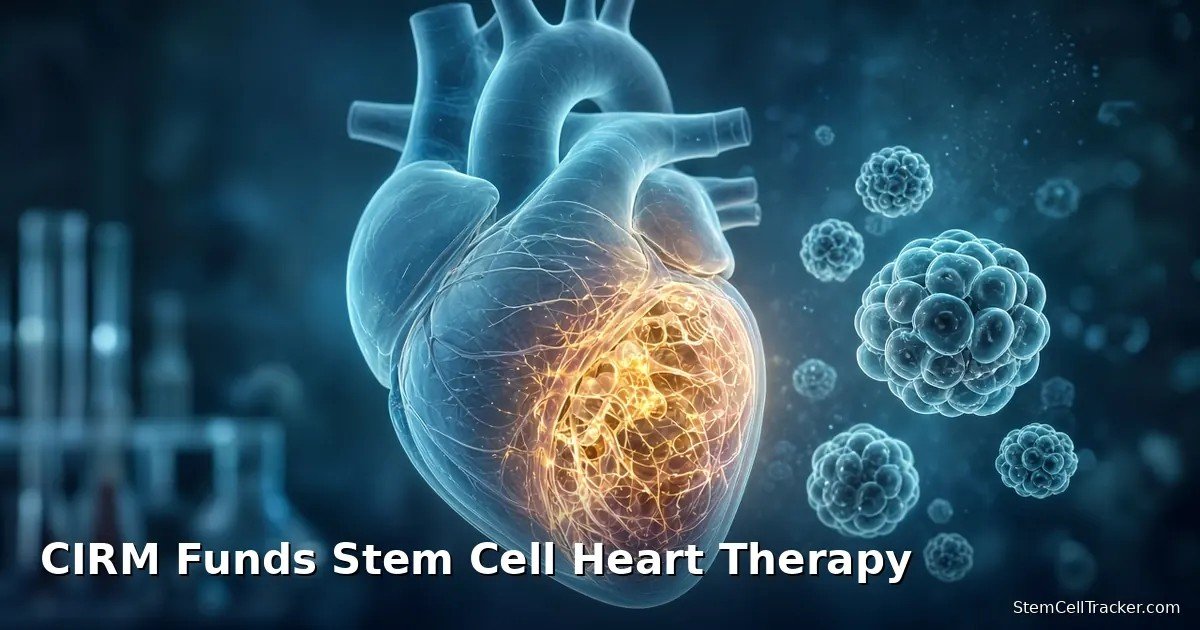
California’s stem cell agency has put $6.9 million behind a University of Southern California effort to turn lab-grown heart muscle into a real clinical shot at repairing the worst kind of heart attack damage. The California Institute for Regenerative Medicine (CIRM) award funds the last preclinical steps needed before regulators can clear a first-in-human study of an investigational stem cell heart therapy made from induced pluripotent stem cells (iPS cells).
According to a Nov. 5, 2026 news release, human trials aimed at safety and feasibility are targeted for late 2027, with planned sites at USC and the University of Washington. CIRM’s money is meant to pay for the manufacturing, animal safety work, and paperwork the Food and Drug Administration needs before those trials can start. Separate clinical-trial support from the Marcus Foundation was already covered earlier by Stem Cell Tracker.
What the stem cell heart therapy is designed to do
After a severe heart attack, chunks of beating muscle die and turn into scar. Drugs and devices can stabilize people and help the remaining heart work harder, but they do not put the lost muscle back. Think of it like losing bricks from a load-bearing wall: braces help, but the wall is still missing material.
Chuck Murry’s USC Stem Cell team is developing ventricular heart-muscle cells grown from human iPS cells—adult cells reprogrammed to an embryonic-like state, then steered into heart muscle. The investigational product, called SCM-101 in CIRM’s public review materials, is an allogeneic (“off-the-shelf”) cell therapy meant for people with a recent heart attack who go into cardiogenic shock and need mechanical circulatory support.
That group is small but extremely high risk. CIRM’s grant summary notes cardiogenic shock after a heart attack affects roughly 10% of heart-attack patients and carries about a 50% one-month mortality rate even with today’s best care. Survivors often slide into progressive heart failure.
Stem Cell Tracker Analysis
We dug past the headline into CIRM’s public award record and the Grants Working Group (GWG) review summary for application PDEV-19727 (“Regenerating the Acutely Infarcted Heart with iPSC-Ventricular Cardiomyocytes”). Details other outlets largely skipped:
- Exact award: CIRM lists an active Preclinical Stage Projects grant of $6,891,118 to Charles Murry at USC (CIRM investigator page). Reviewers scored the application a median 90/100 (“exceptional merit”).
- What CIRM is paying for: IND-enabling manufacturing and pharmacology/toxicology studies, a clinical protocol and operations plan, and filing an Investigational New Drug (IND) application with the FDA.
- How cells would be delivered: Reviewers describe trans-epicardial injection into infarct and peri-infarct muscle (a surgical approach that can be minimally invasive), not a simple IV drip.
- Dose and retention math: Reviewers note cell retention is hard. A potency assay with roughly >25–35% retention would convert to an effective dose on the order of 50–160 million cardiomyocytes. Starting low may matter because engraftment arrhythmias appear dose-related in large-animal work.
- Immune and rhythm risks: Because SCM-101 is allogeneic, patients would need immunosuppression. Reviewers flag that as especially delicate in people already on ECMO and/or Impella. Large-animal studies also showed transient engraftment arrhythmias; arrhythmia monitoring and drug management are built into the planned safety analysis.
- Manufacturing maturity: The team already has GMP master and working cell banks and has scaled production into the billions of cells in process development—important if a therapy needs huge cell numbers per patient.
- Indication shift: Reviewers note the program recently moved from chronic heart failure toward acute post-MI cardiogenic shock, arguing that remuscularizing early—before dense scar locks in—could change the trajectory. That shift still needs FDA confirmation.
In short: this is not a clinic-ready cure. It is a well-scored, late-preclinical bet that living heart-muscle cells can replace what a heart attack destroys—if manufacturing, immune management, and rhythm safety hold up under FDA scrutiny.
How this fits prior heart regeneration research
Murry’s group has spent years showing that iPS cell–derived cardiomyocytes can engraft and couple electrically in animals ranging from rats to macaques. That track record is why CIRM reviewers called the science “best in class.” It also explains why the Marcus Foundation’s earlier $28.7 million commitment focused on getting an ~18-patient first-in-human safety study ready for 2027 at Keck Hospital of USC and the University of Washington.
Today’s CIRM award fills a different gap: the costly IND package that sits between promising animal data and that first patient. For a broader primer on how iPS cells work, see our guide to stem cells explained.
What This Means for Patients
If you or a loved one is recovering from a heart attack, nothing about this announcement changes care today. SCM-101 is still preclinical. CIRM funding moves paperwork, manufacturing checks, and animal toxicology—not a pharmacy shelf. The earliest human testing described publicly is a small late-2027 safety and feasibility study, not a large trial that proves people live longer or feel better.
Who might eventually be studied first? People with a recent heart attack who develop cardiogenic shock and need mechanical support. That is a narrow, critically ill group—not every heart-attack survivor, and not people shopping for elective “stem cell boosts.” Even if trials succeed, immunosuppression, surgical delivery, and arrhythmia risk mean this would be hospital medicine, not a weekend infusion.
Be wary of clinics that already sell heart “stem cell” packages. Unproven offerings are a known problem; our stem cell clinic red flags checklist explains how to spot them. Talk with a cardiologist about proven treatments, clinical-trial registries, and whether any legitimate study is open. This article is education, not medical advice.
Sources
- EurekAlert / Keck School of Medicine of USC: CIRM awards $6.9 million to move cell therapy for heart attack to clinical trials (Nov. 5, 2026)
- CIRM award page: Regenerating the Acutely Infarcted Heart with iPSC-Ventricular Cardiomyocytes (PDEV-19727)
- CIRM: Charles Murry investigator awards
- CIRM PDEV 26.1 ICOC public summaries (PDF) — GWG review of PDEV-19727 / SCM-101
- USC Stem Cell: Regenerating the Heart
Reviewed by Ty Lancaster, Editor. Stem Cell Tracker uses AI tools to help research and draft stories; see our Editorial Policy. This article is for education only and is not medical advice.