

A cultivated steak must be more than a collection of muscle cells. It needs structure.
Real muscle is a complex, living tissue made up of multiple interacting cell types. Muscle fibers develop alongside connective tissue, nerves, and blood vessels that supply oxygen and nutrients. Reproducing that organization outside an animal has been one of the central challenges in moving cultivated meat beyond minced or highly processed products.
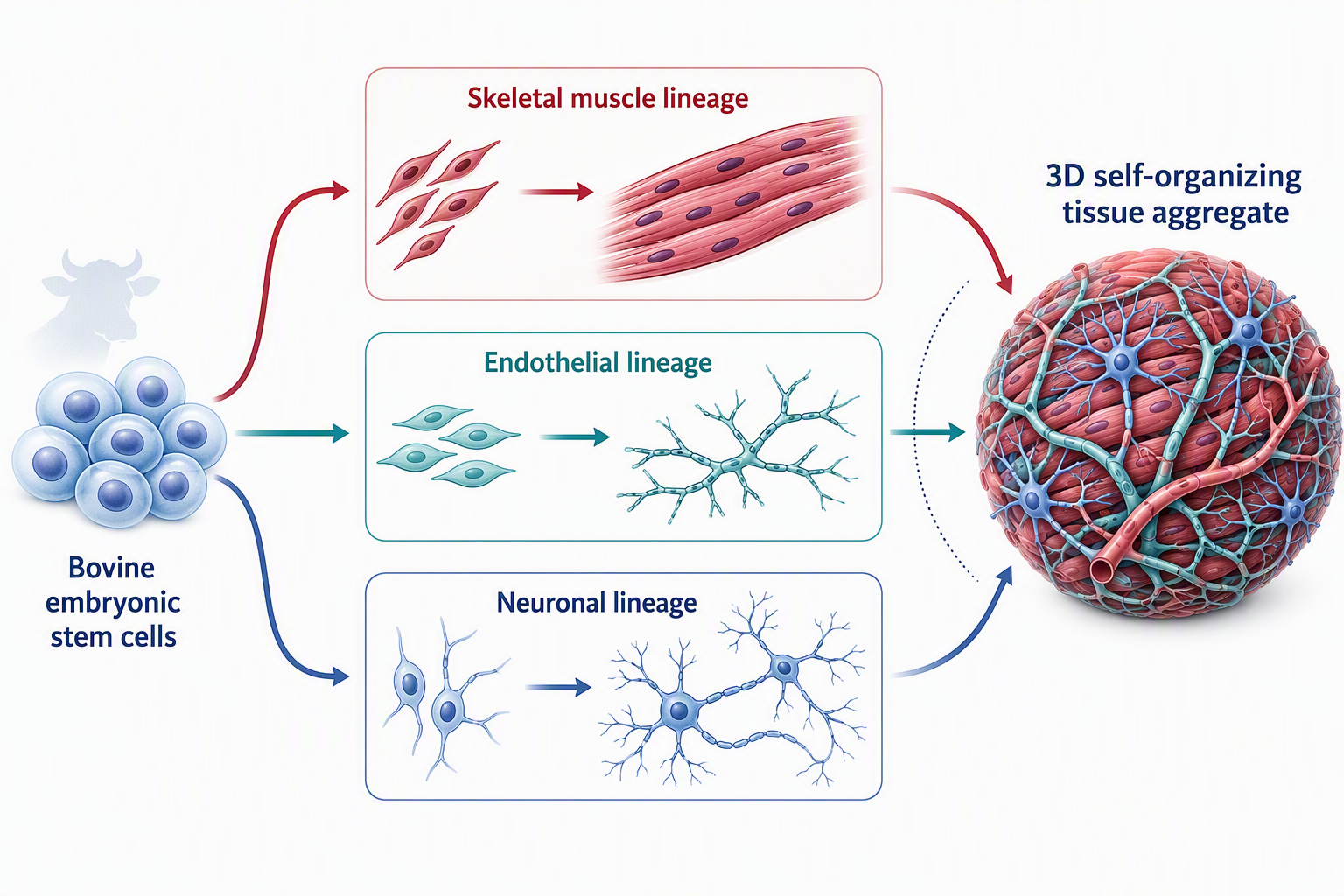
A new study published in Nature Communications reports an important step toward that goal. Researchers developed a method for growing self-organizing bovine tissues from a laboratory-grown line of bovine embryonic stem cells. The resulting three-dimensional aggregates contained skeletal muscle cells together with endothelial cells capable of forming blood vessel-like networks and spinal neurons that interacted with the muscle.
The work does not produce a cultivated steak, as some headlines suggest in order to sensationalize the news. The tissues were only about 0.6 millimeters in diameter and were generated over 15 days. But the study demonstrates a capability that could prove essential for more realistic cultivated beef: several relevant tissue components can emerge together from a common developmental program rather than being grown separately and assembled afterward.
Why this is a significant result
Most cultivated meat research focuses on obtaining cells, expanding them, directing them toward muscle or fat, and organizing them into a food product. That approach is biologically powerful, but it can become increasingly difficult as the target tissue becomes thicker and more complex.
A simple cell mass can often receive nutrients by diffusion over short distances. A larger tissue cannot depend on diffusion alone. Cells located deep inside the tissue may become oxygen-deprived or fail to receive enough nutrients unless the tissue contains an effective transport network.
In living animals, blood vessels solve that problem. They deliver oxygen and nutrients while removing metabolic waste. Creating vascularized tissue – or at least tissue containing functional vessel-like networks – is therefore an important objective in tissue engineering and cultivated meat research.
The new study’s endothelial networks are still primitive and are not equivalent to a mature circulatory system. Their importance lies in showing that vascular and muscle components can form within the same self-organizing tissue context.
What the researchers did
The team used an established bovine embryonic stem cell line. Unlike many adult stem cell populations, embryonic stem cells can proliferate over extended periods while retaining the ability to develop into multiple cell types.
By guiding the cells through a controlled differentiation process, the researchers generated three major components at the same time:
- Skeletal muscle cells, which provide the core contractile tissue.
- Endothelial cells, which can organize into blood vessel-like networks.
- Spinal neurons, which interact with developing muscle and contribute to neuromuscular organization.
The cells then formed three-dimensional aggregates without requiring researchers to manufacture each component separately and manually assemble the final structure. This behavior is known as self-organization: cells arrange themselves into a more complex structure through coordinated developmental processes.
That distinction matters. In principle, a self-organizing system could be more biologically faithful and less dependent on complicated assembly steps. It may also provide a useful model for studying how muscle, nerves, and vascular tissues influence one another during development.
Embryonic stem cells broaden the cultivated-meat toolkit
Many cultivated beef approaches use adult bovine cells, including satellite cells and other muscle progenitors. These cells are valuable because they are already relatively close to a muscle fate and can produce muscle tissue in culture.
Their limitations are also well established. Adult primary cells have finite expansion capacity, may undergo senescence after repeated passages, and generally have a narrower developmental range. Those characteristics create challenges when researchers want both a renewable cell source and the cellular diversity found in complex tissue.
Bovine embryonic stem cells offer a different starting point. Their long-term proliferative capacity could support the creation of larger, more consistent cell banks. Their developmental flexibility could also allow researchers to generate several interacting cell types from one source.
That does not make embryonic stem cells automatically suitable for food production. The cells must still be expanded under appropriate conditions, differentiated efficiently, characterized carefully, and produced using materials and processes compatible with food safety requirements. Ethical, regulatory, and public-acceptance questions may also differ from those associated with adult-cell systems.
The study’s contribution is therefore best understood as an expansion of the biological toolkit, not as a complete production solution.
The study does not yet make cultivated steak possible
The most important limitation is scale.
The researchers produced tissue aggregates approximately 0.6 millimeters in diameter in 15 days. That is large enough to demonstrate multicellular organization, but far smaller and less mature than a steak. The vessel-like networks were also early-stage structures rather than fully functional blood vessels capable of supporting a thick piece of meat.
To move from proof of concept to a steak-like product, researchers would need to address several separate problems:
Tissue thickness and nutrient transport
Larger tissues require better internal transport. Researchers will need to determine whether the vessel-like networks can mature, connect, and support sustained growth. They may also need to combine self-organization with engineered perfusion systems, scaffolds, or bioreactors.
Muscle maturation
The presence of skeletal muscle cells is not the same as the presence of mature, food-quality muscle tissue. Contractile function, fiber organization, extracellular matrix, fat integration, texture, and protein composition will all influence the final product.
Culture cost
The study reports that the current process depends on costly culture media and reagents. That is a major obstacle for any food application. A process can be biologically elegant and still be economically impractical if its inputs are too expensive at production scale.
Manufacturing scale
Producing small aggregates in a laboratory is fundamentally different from producing large quantities of consistent tissue. Industrial systems would need to control cell density, oxygen, nutrients, waste, temperature, contamination, and batch-to-batch variation.
Food-grade validation
A future cultivated-beef product would require extensive characterization of cell identity, genetic stability, residual materials, microbial safety, nutritional composition, and manufacturing consistency. The research platform is an early scientific model, not a regulatory approval pathway.
Why the result may matter beyond cultivated meat
The study is relevant to cultivated meat, but its value is broader than food production.
A multicellular bovine tissue model containing muscle, endothelial cells, and neurons could help researchers investigate developmental biology and tissue engineering. It may offer a more realistic system for studying how different cell types communicate during muscle formation than a single-cell-type culture.
The platform could also help identify which developmental signals are necessary for coordinated tissue organization. Those insights may inform future methods for producing engineered muscle, improving vascularization, and designing more complex tissue models.
For cultivated meat researchers, that basic biology is directly relevant. Understanding how tissues form may be just as important as finding ways to grow more cells.
What researchers should watch next
The next phase of work will likely focus on whether the system can be made larger, more mature, and less expensive. Particularly important questions include:
- Can the endothelial networks mature enough to support thicker tissue?
- Can the tissues be grown in perfused bioreactors rather than static culture?
- How closely do the engineered muscle fibers resemble bovine skeletal muscle in structure and function?
- Can fat cells and connective-tissue components be integrated into the same system?
- Which culture-media components are essential, and can they be replaced with more economical, food-compatible alternatives?
- Does the self-organizing approach remain reproducible across larger batches?
- How should researchers evaluate texture, nutrition, safety, and sensory properties as the tissue becomes more complex?
These questions show why the breakthrough should be described carefully. The study is not evidence that cultivated steak is ready for consumers. It is evidence that developmental biology may help researchers address a problem that cell expansion alone cannot solve.
The bottom line
The new bovine stem cell study advances cultivated beef research by shifting attention from isolated cell types to organized tissue systems. By generating muscle, endothelial cells, and neurons together, the researchers demonstrated an early form of tissue self-organization that could eventually support more realistic cultivated products.
The immediate achievement is modest in size but substantial in biological significance: 0.6-millimeter tissues formed in 15 days, with multiple interacting cell types and primitive vessel-like networks.
The path to cultivated steak remains long. Larger tissues, mature vascular networks, lower-cost media, scalable bioreactors, food-grade inputs, and rigorous safety testing are still required. But the study identifies a promising direction: rather than constructing every component separately, researchers may be able to guide stem cells to build more of the tissue architecture themselves.
For the cultivated-meat field, that could be an important change in strategy – from growing cells toward growing organized tissue.
Which challenge do you think will determine the future of cultivated steak: vascularization, cell culture cost, tissue maturation, manufacturing scale, or regulation? Share your perspective with the StemCellTracker.com research community in the comments below.
Sources and publishing notes
Primary study: “Self-organization of vascularized muscle from bovine embryonic stem cells,” Nature Communications, published September 2, 2026. DOI: 10.1038/s41467-026-76569-2. – https://www.nature.com/articles/s41467-026-76569-2
News coverage: “Bovine stem cells offer new approach to future cultivated steak research,” Phys.org, September 2, 2026, reporting information supplied by the European Molecular Biology Laboratory. – https://phys.org/news/2026-08-bovine-stem-cells-approach-future.html